2025-12-05 12:02:15
FSU VS FSRU
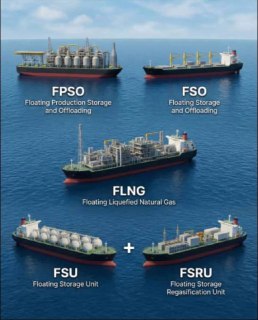
Comparison between FSU (Floating Storage Unit) and FSRU (Floating Storage and Regasification Unit) — commonly used in LNG industry.
FSU vs FSRU
1. Floating Storage Unit (FSU)
Function:
A vessel used purely for storage of LNG. It does not regasify LNG.
Key Features:
》Acts as a floating LNG warehouse.
》Often converted from older LNG carriers (cheaper option).
》Designed to store LNG over long periods.
》LNG must be transferred to another facility (onshore terminal or FSRU) for regasification.
Typical Use Cases:
》Seasonal or strategic LNG storage.
》Buffer storage for LNG import terminals.
》Support for peak shaving operations.
Advantages:
》Lower capital cost than FSRU.
》Simpler operation and maintenance.
》Can be deployed quickly if LNG storage is required.
Limitations:
》Cannot send out gas to pipeline.
》Requires an external regasification facility.
2. Floating Storage and Regasification Unit (FSRU)
Function:
A vessel capable of both storing LNG and regasifying it into natural gas for pipeline delivery.
Key Features:
⭐Integrated regasification system (vaporizers, HP pumps, send-out pipelines).
⭐Can operate as a full-fledged LNG import terminal.
⭐Also often converted from LNG carriers or built new.
Typical Use Cases:
⭐Rapid deployment of LNG import terminals.
⭐Countries needing flexible, mobile gas supply.
⭐Short-to-medium-term LNG-to-power projects.
Advantages:
⭐Provides complete LNG regasification solution offshore or nearshore.
⭐Much faster to deploy than building onshore terminals.
⭐Can be relocated to other markets when contract ends.
Limitations:
⭐Higher CAPEX and OPEX than FSU.
⭐More complex operations.
⭐Requires stable downstream pipeline infrastructure.
#seaformatoffshore
Comparison between FSU (Floating Storage Unit) and FSRU (Floating Storage and Regasification Unit) — commonly used in LNG industry.
FSU vs FSRU
1. Floating Storage Unit (FSU)
Function:
A vessel used purely for storage of LNG. It does not regasify LNG.
Key Features:
》Acts as a floating LNG warehouse.
》Often converted from older LNG carriers (cheaper option).
》Designed to store LNG over long periods.
》LNG must be transferred to another facility (onshore terminal or FSRU) for regasification.
Typical Use Cases:
》Seasonal or strategic LNG storage.
》Buffer storage for LNG import terminals.
》Support for peak shaving operations.
Advantages:
》Lower capital cost than FSRU.
》Simpler operation and maintenance.
》Can be deployed quickly if LNG storage is required.
Limitations:
》Cannot send out gas to pipeline.
》Requires an external regasification facility.
2. Floating Storage and Regasification Unit (FSRU)
Function:
A vessel capable of both storing LNG and regasifying it into natural gas for pipeline delivery.
Key Features:
⭐Integrated regasification system (vaporizers, HP pumps, send-out pipelines).
⭐Can operate as a full-fledged LNG import terminal.
⭐Also often converted from LNG carriers or built new.
Typical Use Cases:
⭐Rapid deployment of LNG import terminals.
⭐Countries needing flexible, mobile gas supply.
⭐Short-to-medium-term LNG-to-power projects.
Advantages:
⭐Provides complete LNG regasification solution offshore or nearshore.
⭐Much faster to deploy than building onshore terminals.
⭐Can be relocated to other markets when contract ends.
Limitations:
⭐Higher CAPEX and OPEX than FSU.
⭐More complex operations.
⭐Requires stable downstream pipeline infrastructure.
#seaformatoffshore